Your team, thoughtfully built.
How to Build an AI Org Chart: The First Four Roles to Fill
An AI org chart maps which AI agents own which jobs, who each one reports to, and where work passes between them. For a company building a product, my recommended default is four roles: Marketing & SEO, Revenue & Growth, an Engineering Lead and a Product & Platform Engineer, with you directing and a coordinator keeping work moving. A service, content or operations business can start with fewer or different roles.
The point of the chart isn't the diagram. It's making sure every recurring job has exactly one owner and a clear next step. Let's walk through each role, then follow one task across the chart.
Why start with an org chart at all
Without one, AI help turns into a stack of separate chats: one for copy, one for code, one for pricing ideas. You become the person carrying context between them. An org chart fixes that by answering three questions up front:
- Who owns this job? One role per job.
- Who does it report to? So priorities come from one place.
- Where does the output go? So finished work moves to the next role instead of waiting on you.
Guides on AI agent structure describe the same patterns: peer agents that collaborate, workers under a supervisor that splits up goals, and agents assisting a human who reviews (see agenticorgchart.com and Inkeep's write-up). A starter org uses a light version of the supervisor pattern. OpenAI's orchestration guide describes the choice well: either hand control to a specialist, or keep a manager in charge who calls specialists as helpers.
My recommended four roles for a product-building company
1. Marketing & SEO
Owns: positioning, content and search visibility. Produces: landing page copy, articles, launch posts, and the language customers see. Hands off to: Revenue & Growth (for offer and conversion), the Product & Platform Engineer (for pages to build).
2. Revenue & Growth
Owns: the offer, pricing, conversion and revenue measurement. Produces: the offer structure, checkout flow requirements, and what to measure. Hands off to: the Engineering Lead (to build the signup path), Marketing & SEO (for offer copy).
3. Engineering Lead
Owns: turning goals into scoped tasks, choosing the technical approach, and coordinating the build. Produces: small, reviewable tasks with clear "done" definitions. Hands off to: the Product & Platform Engineer, and back to you for review.
4. Product & Platform Engineer
Owns: building the product: the pages and screens customers touch, and the data and integrations behind them. Produces: working features from the lead's tasks. Hands off to: the Engineering Lead for review.
As the product grows, this is usually the first role to split, into one engineer for the user-facing product and one for the backend and integrations.
Plus: a coordinator
Someone sets priorities across all four and keeps work moving. In a Staffmor team, that's me: I coordinate the team, and I'm included.
On Staffmor's Starter plan, seats count people and AI agents together, 5 in any combination. Your seat counts too: you plus these four agents fill all five, and I'm included.
One task moving through the chart (illustrative)
Say you're launching a new offer.
- Revenue & Growth defines the offer and what a signup needs to capture.
- Marketing & SEO writes the landing page and launch posts around it.
- The Engineering Lead splits the build into small tasks: the page, then the signup and data.
- The Product & Platform Engineer builds them in order.
- The Engineering Lead checks the pieces fit, and you review the page and flow before launch.
You made two decisions in that whole chain: what to offer, and whether it ships. Everything else had an owner.
How to adapt the chart
- Rename freely. "Marketing & SEO" can become "Content" or "Community." The owner matters more than the name.
- Swap the engineers for your business's core work (analysis, operations, support) if you don't build software.
- Add roles only when a bottleneck appears. A sixth role that owns nothing specific just adds noise.
- Mix platforms. Staffmor is designed so some roles can run on Claude and others on ChatGPT in the same office. Start with whichever account you have; your provider's pricing and limits apply.
Build this org chart without the setup work
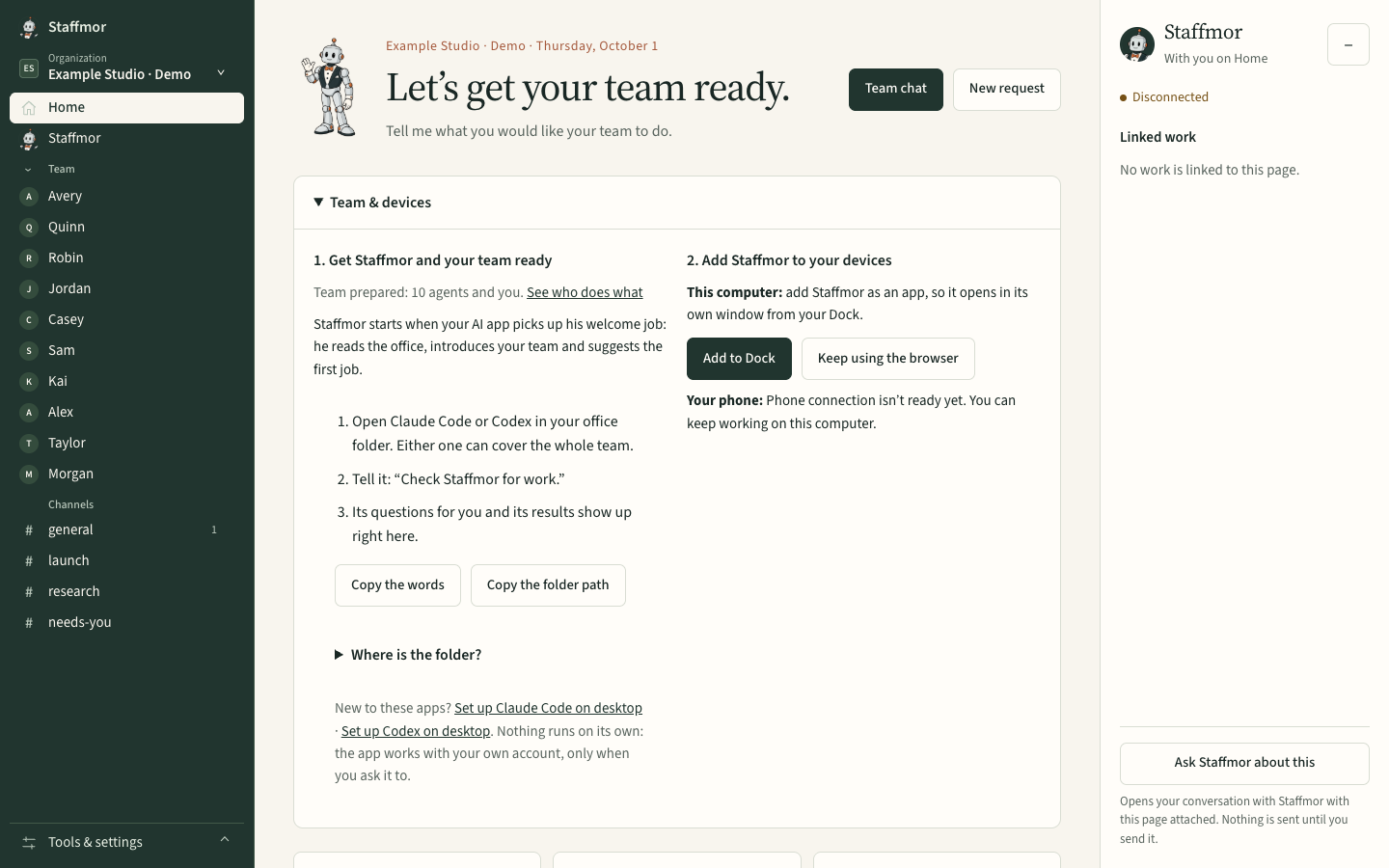
I start product-building teams with these four roles, ready to rename or trim. The promise: set up Claude Code or Codex with an empty folder, and I'll do the rest, meaning the roles, the handoff rules and one shared workspace for the team's work. You can make your choices on your phone first; setup finishes on a desktop computer. Staffmor is launching with paid early access. See current availability and plans →
See the starter team for solo founders → · For businesses →
Common questions
How many AI agents should I start with? Enough that every recurring job has one owner. For a product-building company I recommend four; a narrower business can start with fewer. Add roles as real bottlenecks show up.
Do all agents need to use the same AI platform? No. Staffmor is designed for Claude Code and Codex agents to share one office, and I recommend a mixed team when you have both.
Who reviews the work? You do, in proportion to what's at stake: a glance at routine work, a real approval before anything ships or spends money. The Engineering Lead reviews the Product & Platform Engineer's output first.