Your team, thoughtfully built.
AI Employees for Small Business: Roles, Cost and Setup
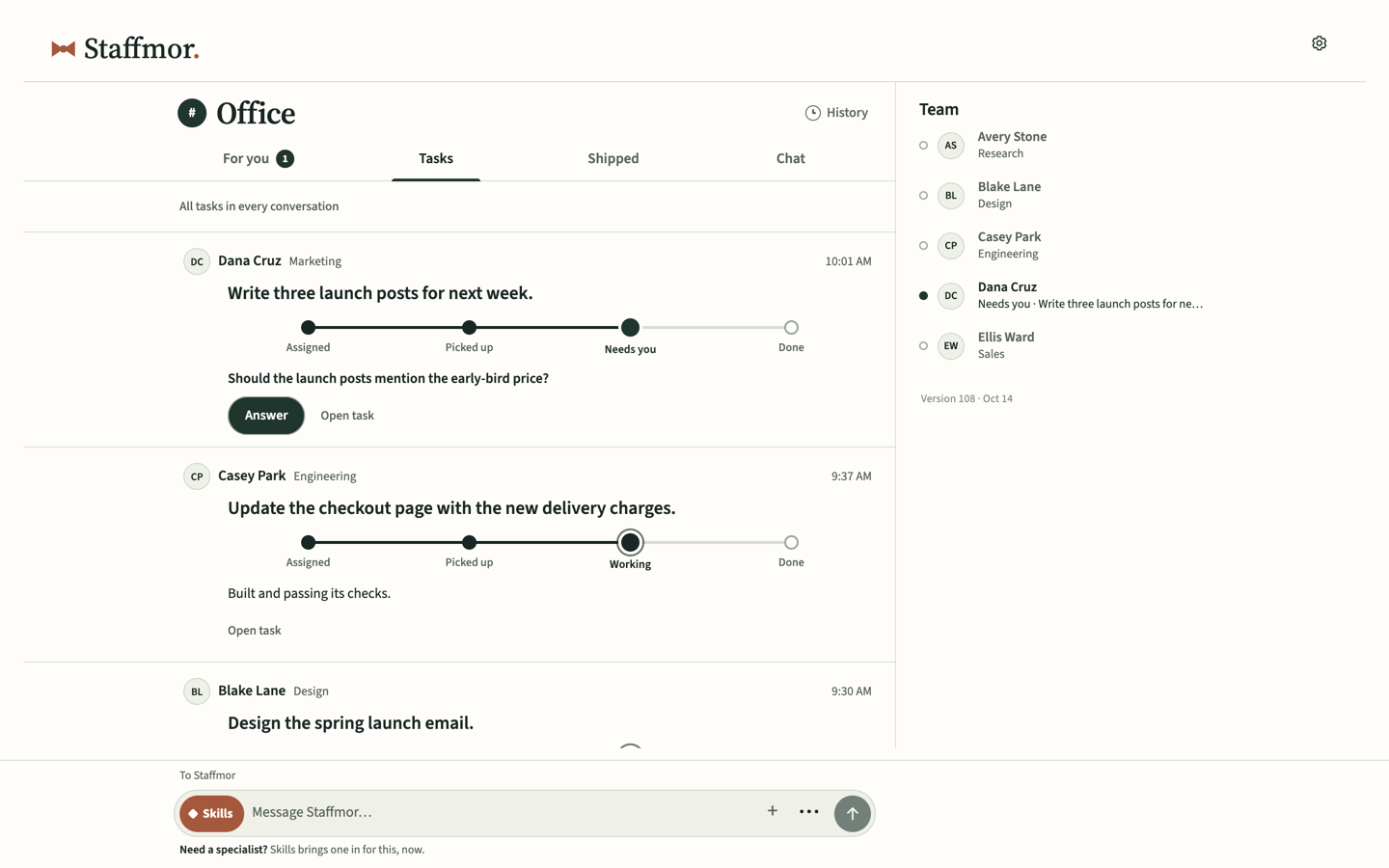
An AI employee is an AI agent with a defined job, the tools and context to do it, and a clear handoff to the next role or to you. You direct the work and review what comes back. In Staffmor, a small business starts with four: an operations lead, customer support, a bookkeeping assistant and a marketing coordinator, working together in one office on your computer through your own Claude or ChatGPT account. Here's what each one does, how work moves between them, what it costs and what stays with you.
What an AI employee is, and what it isn't
An AI assistant answers whatever you type next. An AI employee owns a job. The difference shows up in four things:
- A job. One role owns customer replies, another owns the books. Every recurring task has exactly one owner, so nothing falls between two chats.
- Tools. Each role works with what its job needs: email drafts for support, spreadsheets for the books, posts and newsletters for marketing.
- Context. Your policies, brand voice and past decisions stay with the team, so you stop pasting the same background into every new chat.
- Handoffs. When a job touches another role, the work moves to that role, or to you, instead of waiting for you to carry it over.
What it isn't: a person on your payroll, or a replacement for your judgment. You decide what the team works on, you approve what goes out, and you can rename, change or retire any role. A team gives agents distinct jobs, tools and ongoing context, with handoffs between roles. That lets you staff parts of your business with AI agents while you assign and review the work.
Four AI employees to start with
Tell Staffmor setup you want to grow your business, and it starts you with a small-business front office of four roles. These are their starting names and jobs. Every one is yours to rename or reshape.
Harper, Operations Lead
Owns: the running list of who is doing what, and by when. Works like: calm and organized. Confirms who owns each task and when it's due, and raises risks early. Hands off to: you, for decisions. The other three roles report to Harper.
Quinn, Customer Support
Owns: answering customers, and drafting the emails that do it. Works like: warm, patient and exact. Answers in plain language. Hands off to: you, for anything about refunds or complaints.
Rowan, Bookkeeping Assistant
Owns: bookkeeping, the spreadsheets behind it and the numbers you report on. Works like: careful with numbers. Double-checks totals and asks rather than guessing at a missing receipt. Hands off to: Harper, and you for anything that doesn't add up.
Sage, Marketing Coordinator
Owns: social posts and newsletters. Works like: upbeat and practical. Drafts in your brand voice and notes what worked. Hands off to: you, for approval before anything is published.
Building a product instead? Staffmor's company starter team uses Marketing & SEO, Revenue & Growth, an Engineering Lead and a Product & Platform Engineer. The AI org chart guide walks through that team.
How work moves between them
A made-up example. On Monday a customer writes in: their order arrived damaged, and they'd like a refund or a replacement.
- Quinn drafts a reply in plain language and passes the refund question to you, because refunds are yours to decide.
- You choose a replacement and approve the reply. Your team's rules tell every agent to get your yes before sending anything you haven't approved.
- Harper adds the replacement to the running list, with an owner and a date.
- Rowan records the replacement cost, so the month's totals stay right.
- Sage notes the question for the next newsletter or FAQ draft, if it keeps coming up.
You made one decision. Four jobs moved without you carrying context from chat to chat. That's what AI employees are for: not more answers, but work that keeps moving to the right owner.
What AI employees cost
Two monthly bills, and you may already pay one of them:
- Staffmor seats. A plan counts people and AI agents together: Starter has 5 seats, Team 10 and Organization unlimited. Your seat counts too, so you plus the four front-office roles fill a Starter office exactly. Staffmor's own coordinator is included and doesn't use a seat.
- Your own AI account. Your agents do their work through your Claude or ChatGPT account, and Anthropic or OpenAI bills that usage under your plan's pricing and limits. Claude Code comes with Claude Pro or higher (Anthropic), and Codex with any ChatGPT plan (OpenAI).
That's the whole cost: a membership, plus the AI account behind it. Weigh it against the hours each job takes you today, and start with the role that would free the most of them. See the plans →
What stays with you
AI employees take the drafting, tracking and checking off your plate. The decisions stay yours:
- Anything that leaves the business. Your team's rules tell every agent to get your yes before sending, buying or publishing anything you haven't approved.
- Money and promises. Refunds, complaints and commitments come to you. Quinn's role hands them over by design.
- Review. Glance at routine work, and read closely before anything reaches a customer. Our guide to reviewing AI work covers what to check.
Hire your first AI employees
Set up Claude Code or Codex with an empty folder. Staffmor prepares the office after your approvals: the four front-office roles, their handoff rules and one shared office where the work lives, on your computer. Start with the AI account you already have and add the other to the same office later, keeping your team and its history. You can make your choices on your phone; setup finishes on a desktop computer. See Staffmor for businesses → · Set up your office →
Your own AI account does the work, and nothing installs or connects until you approve it.
Common questions
Are AI employees real employees? No. They're AI agents with defined jobs. They don't replace your judgment, and you stay responsible for what your business sends and decides.
Can I change the roles? Yes. Every role can be renamed, re-described or removed, and you can add roles as real bottlenecks show up.
Do I need both Claude and ChatGPT? No. Start with either and add the other to the same office later. Not sure which to start with? Read Claude Code vs Codex.
Will an AI employee act without asking? Your team's rules tell every agent to get your yes before sending, buying or publishing anything you haven't approved, and Claude Code's and Codex's own permission controls still apply. More in Is it safe to run AI agents on my computer?
Related: What is an agentic workforce? · How to streamline a business with AI agents
Sources
All read October 14, 2026.