Your team, thoughtfully built.
How a Solopreneur Can Run a Business With an AI Team
A solopreneur can run a business with an AI team by giving AI agents the recurring jobs (marketing, growth, building) and keeping the three things only the founder should do: decide what to make, set the standard, and approve what ships. The shift is from doing every job yourself to directing the people, here the agents, who do them. You're already making the hard calls; let's take the rest off your plate.
The real problem isn't time, it's switching
Solo founders don't just run short on hours. They lose them switching: writing copy at 9, fixing the checkout at 10, answering a pricing question at 11. Each switch costs context. An AI team helps because each job has an owner holding its own context, so you stop being the only thread connecting everything.
Guides written for solo founders land in the same place: a small team of agents covering the jobs that eat the week, while the founder keeps strategy, taste, relationships and the final yes (see Taskade's guide for solopreneurs and Clero's).
What to hand off, and what to keep
Hand off: drafting marketing copy and content, researching competitors and customers, turning a pricing idea into a clear offer page, building pages and features, wiring up signups and data.
Keep: what you're building and for whom, your quality bar, anything that commits money or a customer relationship, and the final approval on what ships.
A starter team for one founder
For a founder building a product, I recommend four roles (a service or content business can start with fewer):
- Marketing & SEO: positioning, content, search visibility.
- Revenue & Growth: the offer, pricing, conversion, what to measure.
- Engineering Lead: turns your goal into small tasks and coordinates the build.
- Product & Platform Engineer: builds the product, from the pages customers see to the data behind them.
On Staffmor's Starter plan, seats count people and AI agents together, 5 in any combination. Your seat counts too: you plus these four agents fill all five, and I'm included.
We break down who owns what in How to build an AI org chart.
One launch, start to finish (illustrative)
You want to launch a new offer this week.
- You tell the team what the offer is and who it's for. Decision one.
- Revenue & Growth drafts the offer structure and what signup needs to capture.
- Marketing & SEO writes the landing page and launch posts.
- The Engineering Lead splits the build into small tasks, and the Product & Platform Engineer builds the page, then the signup and data.
- The Engineering Lead checks it all fits. You review the page and flow. Decision two: ship it.
You made two decisions. The team did the switching.
What it costs, honestly
- Your AI usage: through your own supported Claude and/or ChatGPT account; your provider's pricing and limits apply.
- Your time: directing and reviewing, which is real work. An AI team doesn't make a business effortless; it moves your time from doing to deciding.
- A desktop computer: where the team's workspace runs.
Getting started
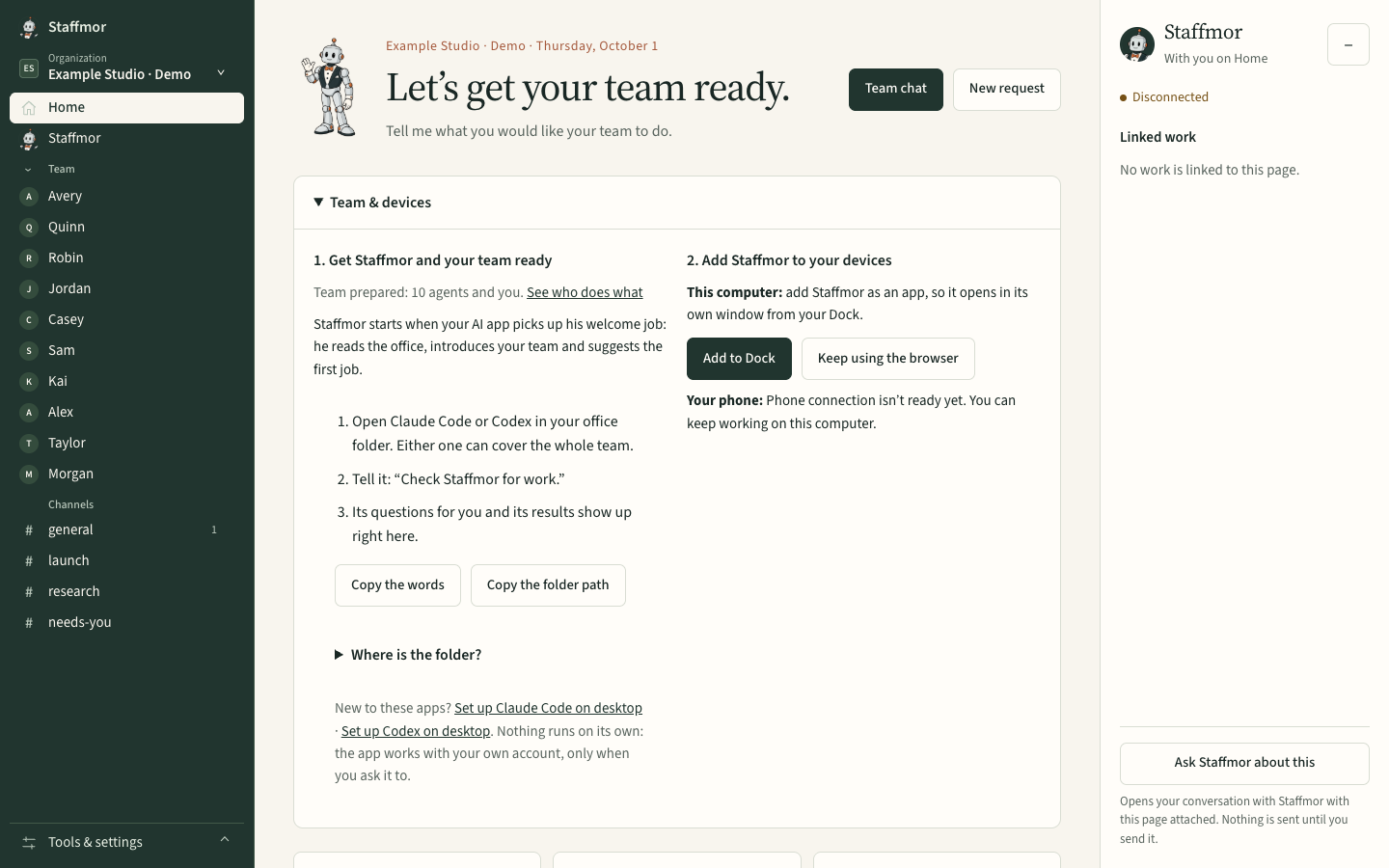
I'm built to set this team up for you. The promise: set up Claude Code or Codex with an empty folder, and I'll do the rest, meaning the four roles, the handoff rules, and one workspace where you give the team its first job. I'm designed so Claude and ChatGPT agents can work side by side in the same office. You can make your choices on your phone first; setup finishes on your computer. Staffmor is launching with paid early access. See current availability and plans →
Common questions
Can one person really run a business with AI agents? One person can direct a team of agents that handles recurring work. You still decide, set the standard and approve. That part doesn't go away.
Do I need to know how to code? No. The engineering roles do the building; you review what they make.
Can I change the roles? Yes. Rename or reassign any of them to fit your business.