Your team, thoughtfully built.
How to Set Up an AI Agent Team: Context, Handoffs and Checks
To set up an AI agent team, decide four things before the first task: what each agent sees, who owns each piece of work, how work passes from one agent to the next, and how finished work gets checked. Give each agent only the context its job needs. Let exactly one agent own each task. Write handoffs down. And require evidence before anything counts as done. The roles tell agents what to do; this setup is what keeps the work from falling apart between them.
Picking the roles comes first (the first four roles to fill). This guide covers what comes after.
1. Decide what each agent sees
It's tempting to give every agent everything. Don't. Anthropic's context-engineering guide treats context as a limited resource: as text piles up, a model can recall any single piece of it less reliably, and the aim is the smallest set of high-signal information for the task (Anthropic).
In practice:
- Shared: the team's goal, the rules everyone follows, and decisions the owner has made.
- Per role: the role's own job, its tools and its files.
- Per task: the request, the relevant decisions and links to sources, so the agent pulls in more only when it needs it.
Anthropic calls that last habit "just-in-time" retrieval: keep references, and load the details when the task needs them.
2. Give every task one owner
When two agents pick up the same request, you get two versions and a merge problem. The fix is simple: an agent claims a task before starting, and nobody else works on it while the claim is held. Only the owner reports on it or hands it off.
3. Write handoffs down
A handoff is a small written brief, not a transcript. A good one says:
| Field | Example |
|---|---|
| What's done | "Landing page draft is in /site/launch." |
| What's next, and for whom | "Revenue & Growth: set the offer and price block." |
| Decisions that still apply | "Owner chose monthly only, no annual plan." |
| Evidence | "Preview link; page passes the build." |
| Open question | "None." |
Anthropic's long-running-agent harness used the same idea: a progress file that each new session reads first, because each session "begins with no memory of what came before" (Anthropic).
4. Make "done" checkable
Agents stop when the work looks finished. Give each kind of work a check that returns pass or fail: tests and a build for code, a screenshot compared with the design for pages, sources linked for research. Claude Code's guidance is to have the agent show evidence, such as the test output or the command it ran, instead of asserting success (Claude Code docs).
5. Keep yourself in the right loop
You don't need to approve every step. You need to see:
- decisions only you can make, one clear question at a time;
- what's in progress, when you want to look;
- finished results, with evidence.
Get the owner's approval before a consequential action outside the scope already granted. Routine work within that scope keeps moving, subject to the tool's controls.
6. Set limits the tools enforce
Write the rules down, but don't rely on writing alone for the important ones. Claude Code and Codex both have permission and sandbox controls, and in its default local mode Codex limits writes to the workspace with network access off (OpenAI). The permission settings you configure decide what each agent can actually do. Keep secrets out of the files agents read.
A setup checklist
- Roles chosen, each with one clear job.
- One short shared instruction file both Claude Code and Codex read.
- A brief for each role: job, tools, handoffs.
- A claim rule: one owner per task.
- A handoff format everyone uses.
- A check for each kind of work.
- One place where decisions come to you.
- Permissions and sandbox settings chosen on purpose.
Or let Staffmor set it up
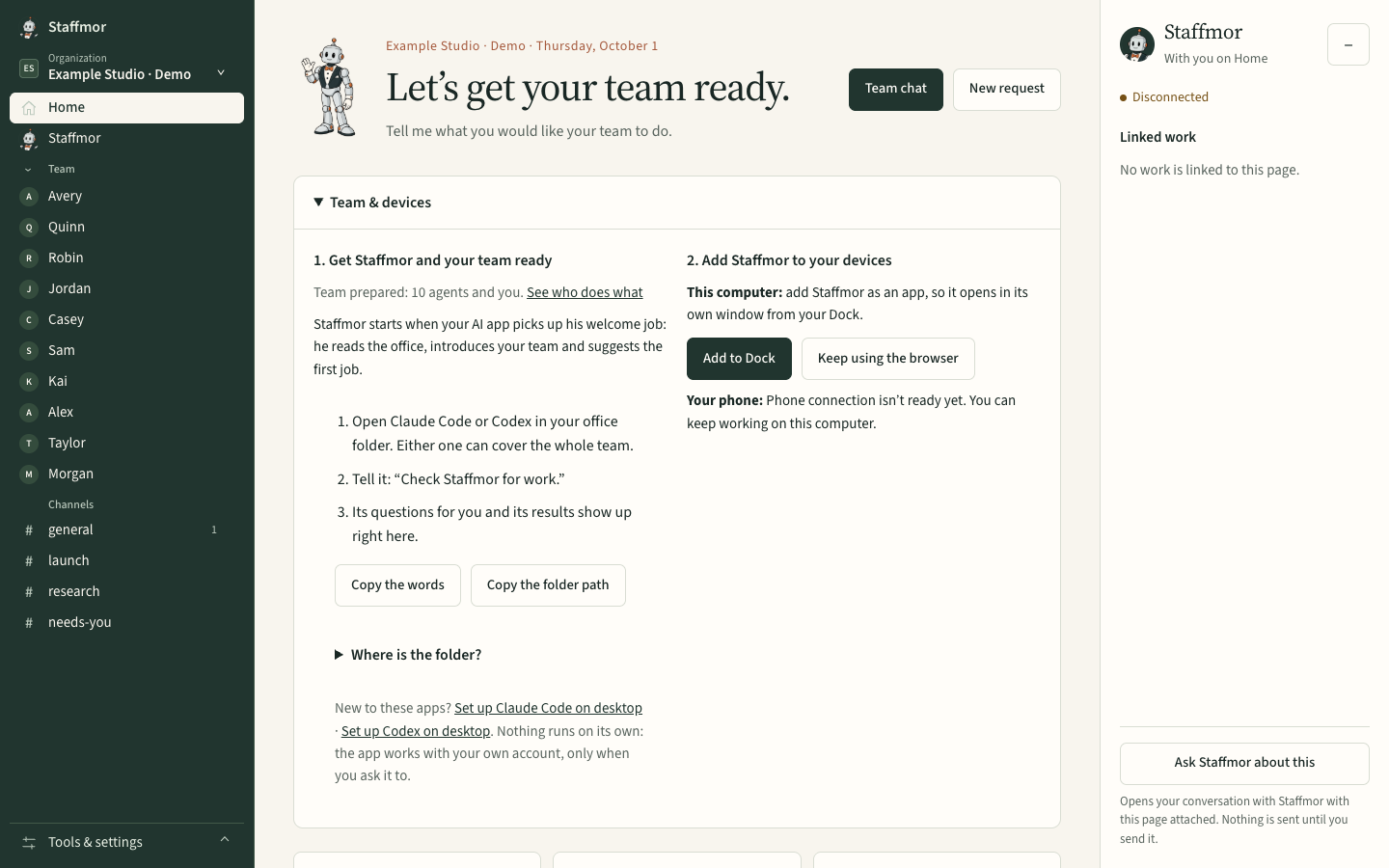
This checklist is what Staffmor sets up from an empty folder.
In our local build today: roles and channels; shared guidance that Claude Code and Codex load through the files they already read (STAFFMOR.md, which AGENTS.md points to and CLAUDE.md imports); one owner per task through claims; a Needs-you home that separates decisions, work in progress and finished results; and compact working guidance plus an editable note of your preferences. Including guidance isn't the same as proven results, so we'll show what it does before we claim more.
Still being built: researched briefs for each role, a living brief of decisions and results, and Claude Code and Codex agents completing work together in one office.
Staffmor is available as a desktop-first beta. Use your own Claude Code or Codex account. See the plans →
Related: What is an agent harness? · How to write instructions AI agents actually follow